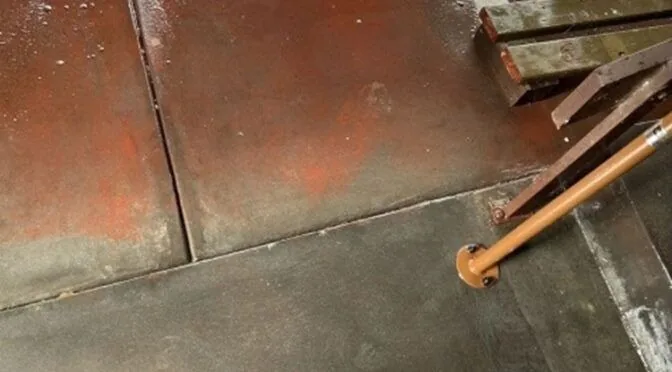
The damage from red oil paint on a floor is usually done by the attempt to remove it, not by the spill. Harsh solvents strip the finish, abrasives scratch it, and scrubbing pushes the pigment further into the grain.
Whether it is a creative accident, a renovation gone wrong, or an unexpected mishap, red oil paint on a floor needs more than effort. It is stubborn, sticky and unforgiving — particularly on porous surfaces like timber or laminate.
Why red oil paint is so difficult
| Property | What it causes |
|---|---|
| Strong pigmentation | Red dyes are highly saturated, so even a small spill leaves a tint or shadow, especially on light-coloured floors |
| Oil binder | It sticks aggressively and dries slowly, so it lifts poorly and spreads easily |
| Penetration | Unlike water-based paint it bonds into surface texture — timber grain, tile grout, vinyl seams |
The three mistakes that cause the real damage
| Mistake | What it does | Instead |
|---|---|---|
| Harsh paint thinners or acetone | Damages the floor’s finish, and can strip colour out of natural timber | Surface-appropriate solvent, tested somewhere hidden first |
| Steel wool, stiff brushes or rough pads | Scratches the surface or leaves permanently dull patches | Microfibre and low-abrasion tools only |
| Leaving it and hoping | The longer it sits the more it cures and bonds — the job gets harder every day | Act early; fresh is dramatically easier than cured |
The one thing worth doing yourself
Act fast, but gently. Blotting a fresh spill with a clean cloth removes a great deal before it cures. What you should not do is start experimenting with solvents on a finished floor — that is where the permanent damage comes from.
How we approach it
The method is chosen for the surface, not the stain. Getting that the wrong way round is what turns a stain into a repair.
Identify the floor and assess the damage
Hardwood, tile, laminate or vinyl — each tolerates a different solvent and a different amount of moisture. This decides everything that follows.
Protect and isolate the area
The surrounding floor is masked or covered so nothing spreads while we work.
Select the solvent
Professional-grade and surface-safe, chosen to break down oil-based pigment without attacking the floor’s finish.
Lift in layers
Microfibre, low-abrasion tools and solvent pads, taking the paint off progressively rather than scrubbing. Detail brushes for textured surfaces, so grooves get reached without damage.
Neutralise and rinse
The cleaning agents are neutralised and the area gently rinsed so no residue is left behind.
Polish and condition
A suitable polish or conditioner restores the finish and protects the surface.
What is realistic
Fresh paint on a sealed floor usually comes off completely. Paint that has cured into unsealed timber, or into grout, may leave a shadow — and at that point the honest answer is refinishing rather than more cleaning. We will tell you which one you have before starting, not after.
We handle paint removal as a one-off, or as part of a deep clean. Send us a photo and we will tell you what is realistic.
Frequently asked questions
Can I use paint thinner myself?
We would not on a finished floor. Thinners and acetone attack the finish and can strip colour from natural timber, so you trade a stain for a bigger repair.
Does it matter how long the paint has been there?
A great deal. Oil paint keeps curing and bonding, so a fresh spill is far easier than one that has sat for weeks.
What if the floor is already scratched from a previous attempt?
Cleaning will not remove scratches. We can take the paint off; restoring the finish afterwards is a floor specialist's job and we will say so.

3 Piglets Cleaning
We are a Croydon-based cleaning company serving Melbourne's eastern and south-eastern suburbs. Our technicians are police-checked and fully insured, and those working with NDIS participants and older clients hold NDIS Worker Screening Clearances. More about us.